










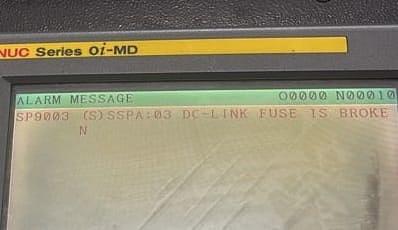
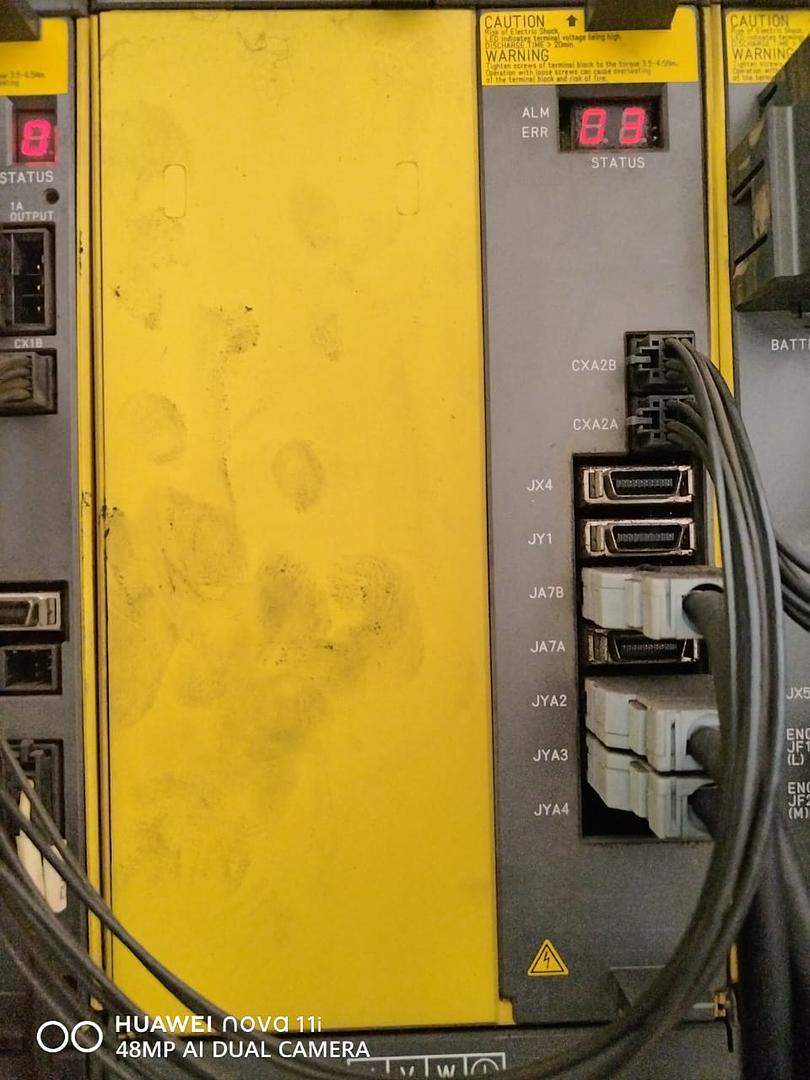
This is a very serious hardware fault alarm, meaning the DC bus fuse inside your FANUC spindle drive has blown.
Based on the model number FANUC SPINDLE 6141 you provided, combined with alarm codes 03 and 9003, the official explanation for this alarm is: "FUSE ON DC LINK BLOWN".
Simply put, the fuse inside the drive has blown. However, please note: a blown fuse is usually a "result," not a "cause." Replacing the fuse or the entire drive hastily without identifying the root cause may lead to further damage to the new component.
Common Causes
Depending on when the fault occurred, troubleshooting can proceed in the following directions:
1. Fault occurs during spindle operation or acceleration/deceleration
In this case, it usually indicates a serious short circuit inside the drive or on the motor side, causing a large current to blow the fuse instantaneously. The main causes include:
· Power component breakdown: Damage to the IGBT or IPM module inside the drive is the most common cause.
• Motor or wiring short circuit to ground: Damage to the power line or internal winding insulation of the spindle motor causes a "grounding" fault.
• Regenerative braking circuit problem: Failure to release braking energy during emergency stop or deceleration can also cause this alarm.
2. Fault occurs during startup or emergency stop release
If the alarm occurs immediately upon startup, the following are simpler causes:
• DC bus connection problem: Check if the DC bus connection between the power supply module (PSM) and spindle module (SPM) is loose or disconnected.
• Control circuit problem: A short circuit in the external 24V control power supply (such as a damaged spindle cooling fan) can also cause the alarm.
Troubleshooting steps
Considering safety and technical requirements, the following steps are recommended:
1. Immediate power disconnection: Stop using the equipment and disconnect the machine tool's main power supply.
2. Professional testing (recommended): Have an electrical technician use a multimeter to measure the insulation resistance of the spindle motor to ground and check for signs of short circuits at the DC bus terminals (P and N) of the driver.
3. Fault Isolation: If a spare part of the same model is available, try replacing the spindle driver first. If the problem is resolved after replacement, the original driver is confirmed to be faulty.
4. Seeking Repair: In most cases, the spindle driver needs to be removed and taken to a professional FANUC service center for repair or replacement.