










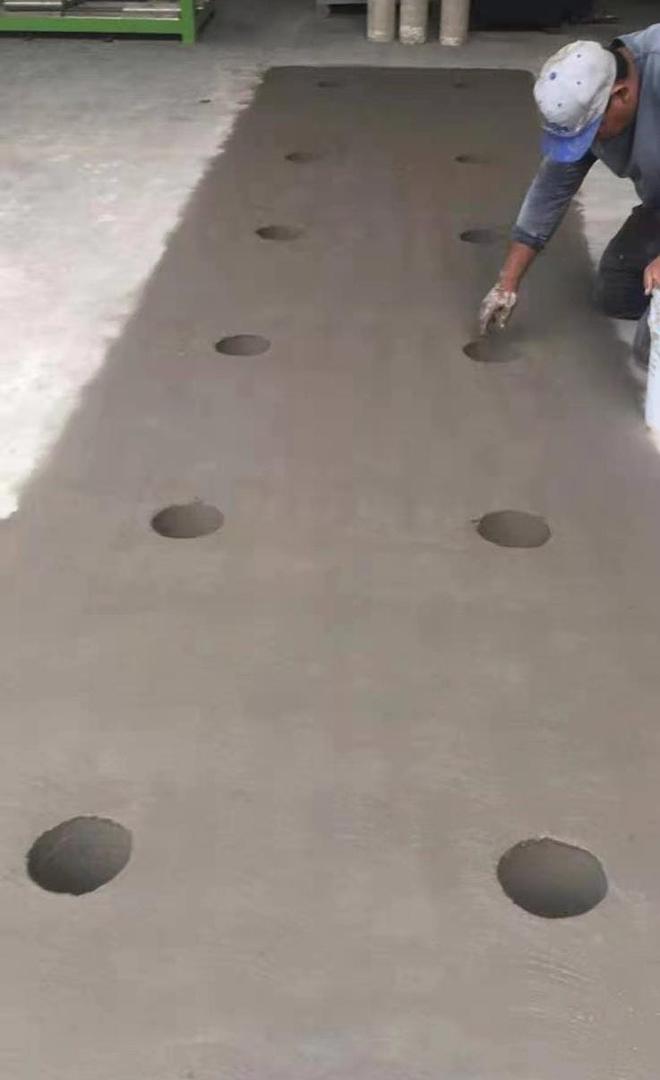
Unmatched Consistency & Quality Control
· Precise Mix Design: Ready-mix concrete is batched at computerized plants under controlled conditions. The ratio of cement, water, aggregates, and admixtures is exact for your project's specific strength (e.g., 3000 psi, 4000 psi), slump (workability), and environmental needs (e.g., freeze-thaw resistance).
· Eliminates Human Error: Manual mixing on-site is highly variable—too much water one batch, not enough cement the next. This leads to weak spots, cracking, and inconsistent strength throughout the foundation.
· Controlled Curing: Machine-processed concrete allows for systematic curing (using sprinklers, curing blankets, or compounds), which is critical for achieving its full design strength.
Drastic Increase in Strength & Durability
· Higher Compressive Strength: Plant-produced concrete consistently reaches its specified strength. Proper vibration with power screeds and vibrators removes air pockets (voids/honeycombing), creating a denser, stronger matrix.
· Improved Longevity: A consistent, high-density foundation is more resistant to water penetration, chemical attacks, freeze-thaw cycles, and settling, ensuring the structure lasts for decades.
Superior Efficiency & Time Savings
· Speed: A concrete truck can deliver in minutes what would take a crew hours to mix by hand. For any foundation larger than a small shed, manual mixing is impractical.
· Large Volume Placement: Foundations require a continuous, monolithic pour to prevent "cold joints" (weak planes where separate pours meet). Only machine-delivered concrete in large volumes makes this possible.
· Reduced Labor Intensity: It frees your crew from the exhausting, time-consuming task of mixing, allowing them to focus on precise placement, finishing, and quality oversight.
Enhanced Safety
· Reduces Physical Strain: Minimizes heavy lifting and repetitive motion injuries associated with manual handling of bags of cement and aggregates.
· Site Safety: Using pumps and conveyors places concrete exactly where needed, reducing the need for workers to maneuver heavy wheelbarrows over unstable or congested ground.
Critical Precision & Finish
· Laser Grading & Screeds: Equipment ensures the foundation is perfectly level and at the correct elevation, which is crucial for the rest of the construction.
· Power Troweling: For slab foundations, power trowels produce a much harder, smoother, and more professional finish than hand troweling, which is important for floors.
· Proper Consolidation: Only mechanical vibration can effectively consolidate concrete around dense rebar cages and into complex formwork corners, eliminating defects.
Long-Term Cost-Effectiveness
· While the upfront material cost of ready-mix concrete may be higher than bagged mix, you save enormously on labor costs, time, and risk.
· Prevents Costly Failures: The biggest cost saving is avoiding foundation repairs, structural issues, or water damage down the line due to a poor-quality foundation. A machine-processed foundation is an investment in prevention.
To Manage Massive Dynamic Loads & Vibration
· The Problem: Equipment like punch presses, crushers, or large compressors generate significant impact forces and continuous vibration during operation. An inadequate foundation will transmit these vibrations through the factory floor, causing:
· Damage to the machine itself and its alignment.
· Cracks in surrounding structures.
· Malfunctions in other sensitive equipment.
· The Solution: Machine foundations (often large, isolated mass blocks) are designed with sufficient mass and inertia to absorb and dampen these forces. They act as a "sink" for vibration energy. The foundation mass is frequently 3 to 5 times the weight of the machine to stabilize it.
To Provide Extreme Precision & Stability
· The Problem: Precision equipment like CNC machining centers, coordinate measuring machines (CMMs), or lithography systems require sub-millimeter or even micron-level stability. Any uneven settlement or thermal movement in the foundation causes misalignment and scrapped products.
· The Solution: The foundation must be an immovable reference plane. This is achieved through deep foundations (piles), high-strength concrete, controlled curing, and sometimes a complete separation from the building's floor (an isolated inertia block).
To Resist Complex Stress Patterns
· The Problem: Machines don't just push down; they exert twisting (torque), rocking, and horizontal forces.
· Rotating Equipment (turbines, large motors) generate torque.
· Reciprocating Equipment (piston pumps, diesel engines) create cyclic horizontal and overturning moments.
· The Solution: The foundation is heavily reinforced with a dense steel rebar cage designed to resist tensile, shear, and torsional stresses. It is engineered as a monolithic, rigid block that won't crack or deform under these complex loads.
For Vibration Isolation & Containment
· The Problem:
· Isolation IN: Sensitive equipment (e.g., electron microscopes, labs) must be isolated from ambient vibrations in the environment.
· Isolation OUT: Vibratory equipment (e.g., forging hammers, shaking screens) must prevent vibrations from transmitting to the structure.
· The Solution: Use of specialized isolation systems:
· Spring Isolators or Elastomeric Pads: Decouple the machine from the foundation.
· Inertia Blocks with Isolators: A massive block placed on isolators.
· "Floating" Slabs (Raft Foundations): The machine and its base slab are physically separated from the surrounding floor by an isolation gap.
Primary Reasons : Machines are " LIVE" Loads
While buildings impose mostly static, downward weight, machines generate complex, powerful, and often destructive forces.