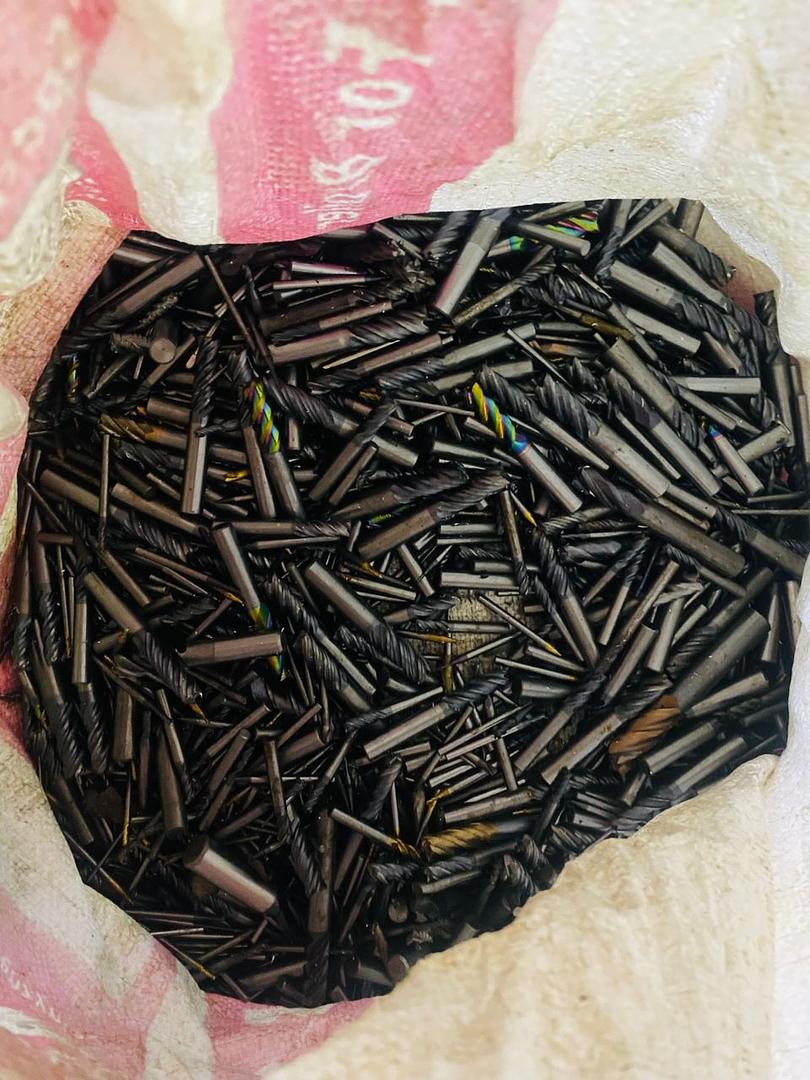










♻️ Recycle Carbide Process (Tungsten Carbide Recycling)
Tungsten carbide (WC) is valuable because it contains tungsten, one of the hardest and most resource-intensive metals. Recycling carbide helps reduce cost and environmental impact.
Below is the standard industrial recycling workflow:
✅ 1. Collection & Sorting
Carbide scraps are collected from:
- CNC machining shops
- Tooling factories
- Fabrication & welding workshops
- Used inserts, end mills, drill bits, wear parts
Materials are sorted into:
- Clean carbide (inserts, end mills, rods)
- Contaminated carbide (brazed, oily, with steel shank)
- Mixed metal scraps
Sorting ensures clean scrap gets maximum recovery value.
✅ 2. Degreasing & De-oiling
Scrap is washed to remove:
- Oil
- Coolant
- Dirt
- Rust
This prevents contamination in the chemical recovery stage.
✅ 3. Crushing & Size Reduction
Large carbide pieces are broken down using:
- Jaw crushers
- Ball mills
- Hydraulic shears
Goal: convert to uniform small pieces so it can be chemically or thermally processed.
✅ 4. Chemical or Zinc Recovery Process
A. Zinc Process (Most Common Worldwide)
1. Carbide heated in molten zinc
2. Zinc penetrates and breaks binder (cobalt)
3. Turns into a powder-like form called zinc-treated carbide
4. Zinc is evaporated and collected for reuse
Result: high-purity WC powder ready for manufacturing new tools.
B. Chemical Recycling (Amonia + Acid)
- Carbide scrap is dissolved or leached to recover:
- Tungsten oxide (WO₃)
- Cobalt
- Tantalum/Niobium (if present)
This method produces ultra-pure tungsten powder.
✅ 5. Powder Refining & Classification
The recovered tungsten powder is:
- Filtered
- Dried
- Sieved
- Graded (particle size control)
This step determines the final quality.
✅ 6. Re-carburizing
- Some processes add carbon back into the powder to restore it to: WC (tungsten carbide) composition
- This ensures the powder meets tool-grade specifications.
✅ 7. Re-manufacturing
The recycled WC powder is used to make:
- New carbide inserts
- End mills
- Drill bits
- Wear parts
- Cutting tools
New tools made from recycled carbide can reach 100% of original performance.
⭐ Benefits of Recycling Carbide
- Reduce raw tungsten mining
- Lower CO₂ emissions
- Save cost (scrap carbide is 3–10× value of steel scrap)
- Sustain supply chain for cutting tools